 DarkWebsite.link
Start here
What is the dark web?
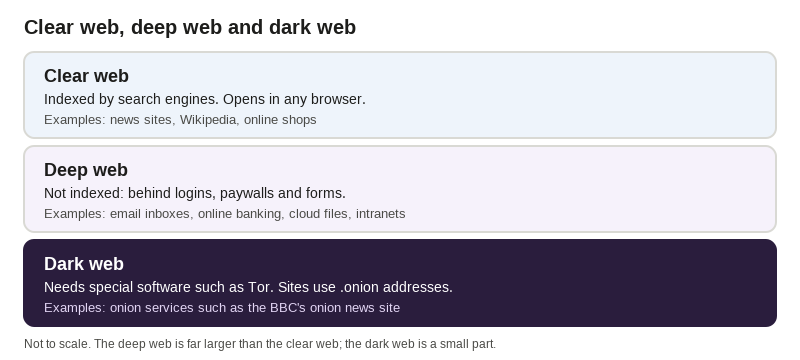
The dark web is a small part of the internet that you can only reach with special software, most often Tor Browser. Its sites use .onion addresses, are not in normal search engines, and hide where the site and its visitors are.
The short answer
The internet you use every day, with Google, news sites and online shops, is the clear web. The dark web is a set of sites on overlay networks: networks built on top of the internet that need their own software. The best known is Tor. Sites on Tor end in .onion and are called onion services. Others exist, such as I2P.
"Dark" means hidden, not "criminal". The network is built to hide who runs a site and who visits it. That protects a journalist's source and a reader under censorship. It also helps people with bad intentions, which is where the reputation comes from.
How the dark web works
- You open Tor Browser, which connects to the Tor network.
- Your traffic is wrapped in several layers of encryption and passed through volunteer-run relays. Each relay knows only the one before it and the one after it.
- An onion service does the same on its side, so you and the site meet in the middle. Neither side learns the other's IP address.
Our guide to how onion services work goes into the detail.
What is actually on the dark web?
A mix, like any part of the internet:
- News outlets such as the BBC and Deutsche Welle, for readers whose governments block them.
- Privacy services such as Proton and Riseup.
- Secure tip lines for journalists, such as SecureDrop, and even a CIA contact site.
- Search engines such as Ahmia, forums, personal sites and software mirrors.
- Criminal sites and scams. These exist, and this site does not list or link to them.
How do you find dark web sites?
Google does not index .onion sites, and there is no complete directory. People find addresses through the organization's own website, through curated lists that say where each address came from, or through onion search engines. Our dark web search engines guide explains the options, and our Hidden Wiki guide explains why the most famous link list is mostly a trap.
How big is it?
Nobody knows exactly, and many figures online are guesses. The Tor Project publishes measured data about the network at Tor Metrics, including traffic to onion services. That is a better source than articles quoting round numbers without a method.
A short history
According to the Tor Project, the idea of onion routing began in 1995, when researchers at the US Naval Research Lab asked whether internet connections could be built that do not reveal who is talking to whom. The Tor Project became an independent non-profit in 2006. In 2021 Tor retired its original 16-character onion addresses in favour of today's longer 56-character version 3 addresses, which is one reason old link lists are full of dead links.
The main risks
- Scams and fake sites, including look-alike addresses that copy real ones. See the Hidden Wiki.
- Malware in downloads, and attacks on out-of-date browsers. See Is Tor safe?
- Illegal content, which can be illegal to view or possess. See the legal guide.
- Your own mistakes, such as logging in to personal accounts. See the safety guide.
Is it safe and legal to look?
In most countries, running Tor Browser and visiting onion sites is legal. What you do there is judged by the same laws as anywhere else. Read Is the dark web illegal?, Is Tor safe? and the safety guide before you start.
Where to go next
- Dark web vs deep web, since people mix them up constantly.
- Verified .onion links to legitimate sites.
- Is my data on the dark web?
- Dark web myths.
Frequently asked questions
- What is the dark web in simple terms?
- It is the part of the internet that needs special software, usually Tor Browser, to reach. Its sites use .onion addresses and hide the location of the server and the visitor.
- Is the dark web the same as the deep web?
- No. The deep web is anything search engines do not index, such as your email inbox or online banking. The dark web is a small, deliberately hidden part of the internet that needs special software.
- Can you get in trouble for visiting the dark web?
- Using Tor Browser is legal in most countries, but some restrict or block it. Illegal activity is illegal wherever it happens. Check the law where you live.
Sources
Checked 23 November 2026. We cite primary sources wherever possible; see our editorial policy.
- Tor Project: About Tor (support)
- Tor Project: History
- Tor Project: Understanding onion services in Tor Browser
- Tor Project blog: Onion service v2 deprecation timeline
- Tor Metrics
Related guides
- Dark web vs deep web
- What is Tor and how does it work?
- Is the dark web illegal?
- Dark web search engines
Looking for addresses? See our 50 verified .onion links, or check one with the onion address checker.